Global market leader with a granulate made of re-cycled glass - "Made in Germany".
The success story of Poraver is a prime example of creativity, stubbornness and fighting spirit!
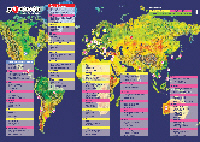 Poraver now delivers to almost all countries in the world
 (firmenpresse) - The history of Poraver
The success story of PORAVER expanded glass gra-nulate began in 1984. However, the motivation of Hans Veit Dennert to develop a high-tech lightweight additive was formed a lot earlier than that.
In the 50's, the Veit Dennert KG family construction business founded in 1933, produced amongst other things large quantities of masonry with the lightweight additive pumice, a natural volcanic product. This product was quarried in Sicily, Greece and the Neuwied Basin in Germany, then transported by ship to the Dennert concrete works. This raw material dependence, together with the greatly fluctuating and, above all, very limited product properties of pumice were the reasons to search for an alternative to pumice.
The search led to expanded clay, a lightweight additive based on an expandable clay. Geologists found a rich source of clay in the Bavarian Postbauer-Heng area, a clay that was suitable for expansion and so a plant was built next to the clay mine in 1960 for the production of expanded clay (the so-called "detoon works").
The aim here however was not that of creating ex-panded clay with similar strengths to pumice (such ex-panded clay was already available in Denmark), but that of producing "high-strength" expanded clay. This could be used to produce not only masonry blocks, but also concrete components made of statically durable, so-called "structural" lightweight concrete.
The tests were successful, leading to worldwide pat-ents and finally to the building of "detoon" plants under license in Mexico and Sardinia. The "roadhouse bridge" on the motorway near Hof, built by Dyckerhoff & Widmann, was one of the first spectacular buildings made with structural lightweight concrete in Germany.
By the end of the 70's it became increasingly obvious that the requirements of the building industry for a high-performance lightweight additive could no longer be fully met by expanded clay.
Increasing ecological requirements and new scientific knowledge therefore led Hans Veit Dennert to search for new raw material sources and further quality im-provements.
This was the beginning of the success story of the ex-panded glass granulate called Poraver.
Expanded glass panels (foam glass panels) were at the time already available in the global market and were viewed as high-quality but very expensive panel material with excellent properties. Ideas for the production of expanded glass granulate were also registered in several patents at the time. But no-one had man-aged to produce expanded glass granulate economically. All the patents required the use of special glass that needed to be specially melted for this purpose and was therefore very expensive.
However, Dennert was fascinated by the idea of replacing the basic material clay with glass for several reasons:
Clay properties vary greatly from region to region and in many areas of the world, clay with expandable properties simply does not exist. In addition, the mining of clay sources results in ecologically unsound interventions in nature and consumption of valuable raw material resources.
The advantages of glass are in contrast impressive: Glass is available around the world with constant quality, it is even available in excess as recycling glass, which must be disposed of at high costs and stored in landfill sites.
But above all, glass has numerous excellent physical properties which make glass not only suitable for technically extremely demanding products such as glass fiber cables, smart windows or capillary tubes, but also perfect for having a positive effect on lightweight additives such as expanded glass.
So, if it were possible to use recycling glass for the production of expanded glass granulates instead of the special expensive glass used until then for expanded glass, the prerequisites for economic expanded glass granulate production would be in place.
In order to find out, Dennert hired the glass expert Alois Seidel in 1980. Seidel successfully worked in the 70's for NASA on the development of the glass heat protection panels for the Apollo capsule. His task now was to develop a formulation on the basis of recycling glass with which it was possible to produce high-quality expanded glass granulate on an economic basis.
After 4 years of intensive research work and very many tests in a test facility - to develop the process technology and cope with the final teething problems - devel-opment was successful. Naturally, this was also a time with many ups and downs: With a complacent smile, the people working there at the time still remember how Hans Veit Dennert personally crawled on all fours through the still extremely hot rotary kiln furnace after the first startup of the new plant. He wanted to find out why the insulation mats were falling off the 950 °C hot rotary kiln furnace. His personal engagement took place on Christmas Eve 1983 when all his employees were already standing around their Christmas tree singing "Silent night, Holy night". But his wife was standing by ready to offer first aid if necessary. Mr. Hans Veit Dennert still has very clear memories of his explorative tour. It was Christmas Eve and his first wedding anniversary, and he spent it mainly searching for the causes of technical problems.
In 1984 the production of expanded clay was finally brought to an end and the new expanded glass production plant took up operation to produce the first and unique creamy-white spherical granules made of 100% recycling glass ready for the market - this was the hour of birth for Poraver.
Themen in dieser Pressemitteilung:
Unternehmensinformation / Kurzprofil:
Multiple usage and application areas
The feather-light and extremely heat insulating Po-raver, originally planned for use as a lightweight additive for the production of bricks and walls, is today the preferred lightweight additive for construction-chemical products around the world.
New application areas and uses are discovered almost on a daily basis through the worldwide activities enhanced by Poraver. Be it in the production of high-quality plastics, modern ship building or promising tests in the automotive, aviation and offshore industries.
Poraver has long since crossed the borders of its origi-nal domain, the construction industry, and made inroads into new application areas such as structural wallpaper, kitchen work surfaces, acoustic panels, fa-cade carrier panels and chemical industry products.
The constant further development and optimization of the PORAVER production process now enables the production of fine-pored spherical granules free of bro-ken granules and grain sizes ranging from 16 mm to the microscopically small 0.04 mm diameter.
The overall production volume has also increased steadily:
- 1992 approx. 5,000 tonnes,
- 1997 around 15,000 tonnes,
- 2003 up to 20,000 tonnes
- 2009 saw 35,000 tonnes being produced.
"PORAVER", a (construction) material that was totally unknown 25 years ago, not familiar to or considered by anyone, not to be found in any standards and a prod-uct that no-one knew what to do with is now popular around the world in important industries and has an excellent image. This is because the company strategy has always, right from the start, focused on the central role played by customer retention as well as vigorous public relations.
Hans Veit Dennert, owner of Dennert Poraver GmbH, explains the company strategy:
"The innovative potential of Poraver is still, due to its numerous positive properties, not exploited to the full. In most cases, the use of Poraver leads to significant improvements in the respective product properties and applications. Hardly any other material can match our application versatility and of course we are ideally placed for the global trend of sustainability. My per-sonal aim is expansion on the global market and the efficient availability of Poraver expanded glass granu-late around the world with state of the art production plants on all continents. The next planning steps are looking at further production sites in North and South America, the Middle East and in Asia."
The first step on a new continent was successfully tak-en in 2009 with the commissioning of a modern and high-capacity plant in Canada. Further licensed plants will follow in the years to come.
Accepted in the database of the future world mar-ket leaders:
The Berlin economics professor Bernd Venohr drew up a list of the top 100 up and coming leading global economy companies in 2008 exclusively for the publi-cations Handelsblatt and Wirtschaftswoche.
In order to be included in this database, the future world market leader needed to meet three criteria: The respective company needed to be within the top 3 in the world in their branch or a leader in Europe, the turnover in 2005 needed to lie below 50 million Euro and have increased by at least 10 percent annually over the previous three years.
The Dennert Poraver GmbH managed to meet all three criteria with its "PORAVER" expanded glass granulate.
While the turnover of the company in 2003 was approx. 8 million Euro, this had already increased to 16 million by 2008. Even the global economic recession last year could not put a brake on the positive company development and Dennert Poraver GmbH managed to ring up the seventh record result in a row in 2009 with a new turnover of 17 million Euro. And the trend goes on. The Poraver team is particularly proud of the fact that Dennert Poraver is the only company in the "Building Materials Speciality" branch that was elected into the top 100 in Germany.
Poraver now delivers to almost all countries in the world and is already active with representation in the following countries:
Australia, Austria, Argentina, Belarus, Bulgaria, Bel-gium, Canada, Chile, China, Croatia, Cyprus, Czech Republic, Denmark, Estonia, Finland, France, Great Britain, Greece, Hungary, India, Ireland, Israel, Italy, Japan, Latvia, Liechtenstein, Lithuania, Luxembourg, Mexico, the Netherlands, North America, Norway, Pe-ru, Philippines, Poland, Portugal, Romania, Slovenia, South Korea, Spain, Sweden, Switzerland, Taiwan, Thailand, Turkey, Ukraine, United Arab Emirates, Vietnam.
Contact for further information:
Philip Brdlik,
Marketing and Public Relations
Dennert Poraver GmbH
Mozartweg 1, 96132 Schlüsselfeld, Germany
Telephone: + 49 9552 92977-11
Fax: + 49 9552 92977-26
E-mail: info(at)poraver.de
Internet: www.poraver.de
PR office & Editorial service
Dipl.-Ing./Ma.-Kfm. Dietmar Haucke,
Hohenzollernstr. 59, 56068 Koblenz
Tel: + 49 261 34066,
Mobile: + 49 163 6434 066
E-mail: creativ-pr(at)creativ-pr.de
Internet: www.creativ-pr.de


Datum: 01.06.2010 - 10:52 Uhr
Sprache: Deutsch
News-ID 21731
Anzahl Zeichen: 0
contact information:
Contact person: Philip Brdlik,
Town:
Schlüsselfeld
Phone: + 49 9552 92977-11
Kategorie:
Business News
Typ of Press Release: Unternehmensinformation
type of sending: Veröffentlichung
Date of sending: 01.06.2010
Diese Pressemitteilung wurde bisher 1205 mal aufgerufen.
Die Pressemitteilung mit dem Titel:
"Global market leader with a granulate made of re-cycled glass - "Made in Germany"."
steht unter der journalistisch-redaktionellen Verantwortung von
Dennert Poraver GmbH (Nachricht senden)
Beachten Sie bitte die weiteren Informationen zum Haftungsauschluß (gemäß TMG - TeleMedianGesetz) und dem Datenschutz (gemäß der DSGVO).


