The key to RFID and Barcoding: Knowing when to use each one
When it comes to RFID and barcoding, both technologies may have their flaws, but the benefits prevail and are thus reason enough to take a closer look at the future.
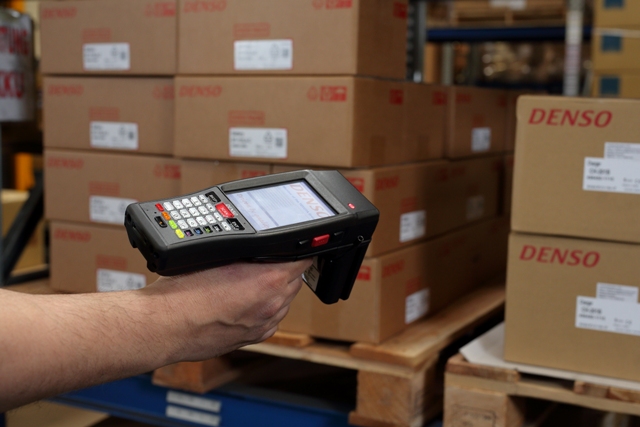
Barcodes are widely used and well established. / Modern RFID technology can quickly read many tags at once. / The skill is to know when to use each one. / DENSO, part of the Toyota group and inventor of the QR Code, knows both RFID and barcoding well. / DENSO’s handheld terminals and scanners are perfect for areas such as retail and logistics, for example. / Further information on the secure handheld terminals and hand scanners with RFID or NFC, mobile data collection, the QR Code, and the DENSO Auto-ID Business Unit is available at https://www.denso-autoid-eu.com/en.html./
(firmenpresse) - Düsseldorf. According to the Smithsonian, the first barcode was written in sand in Miami by inventor Joe Woodland – decades before technology could bring his vision to life. In 1974, the first item marked with the Universal Product Code (UPC) was scanned at the checkout of a supermarket in the small town of Troy in Miami County, Ohio. However, the barcode was not an immediate success. It was when the mass merchandisers adopted the barcode that it took off. Today, the barcode is everywhere – and it is hard to imagine the retail industry, for instance, without it. “The barcode is widely used and well established”, says Viv Bradshaw, Technology Consultant at DENSO Auto-ID, part of the Toyota group and inventor of the QR Code.
Nonetheless, the barcode comes with flaws, too. It needs to be seen to be read, and usually only one barcode can be read at once. “Barcodes are prone to physical damage, which is a disadvantage in areas such as retail and logistics, for example”, says Bradshaw. “Other flaws are the limited storage for 1D barcodes, and the fact that they can be easily reproduced or copied, which is not secure,” he continues. He wants to highlight more advantages of the barcode though. “Barcodes are cheap and easy to produce, and the reading equipment for the barcodes can be inexpensive as well.” Barcodes have been around so much that people understand how to use them. They can even have human readable information, which is useful, if the barcode cannot be read automatically. In addition, the barcode has been further developed – and the QR Code was invented by DENSO.
The key(s) to more security and efficiency
“The QR Code is a 2D barcode and can blur the lines a little with RFID in some situations,” explains Bradshaw. “Our SQRC®, the Secure QR Code, can encrypt sections of the data on the code, making the barcode secure. This version of the QR Code is typically used for ticketing, healthcare, and product authentication,” he goes on. Whilst standard handheld terminals and hand scanners can read the public data on the SQRC®, only DENSO devices for mobile data capture can read the private encrypted data section with the specific data key. However, the cloud-based Q-Revo system can facilitate this decrypting for other mobile data collection devices including mobile phones. This also provides protection against copying of the Secure QR Code. Further information on the QR Code, the SQRC®, secure handheld terminals and hand scanners, solutions for mobile data collection, and the DENSO Auto-ID Business Unit are available at https://www.denso-autoid-eu.com/en.html.
While the QR Code can blur the lines between barcoding and RFID, the latter technology offers numerous advantages, especially in retail and logistics. Where time and costs are crucial, RFID can quickly read many tags at once, while the tags can be hidden and generally still be read. Thus, time and cost savings are achieved.
However, there are reading limitations: Some software does not support RFID. Also, tags are expensive compared to barcodes. Some reading equipment, such as handheld terminals and hand scanners, can be expensive, too. “Of course, every technology has its flaws. With RFID, the advantages prevail though. RFID is available in many formats and can be made robust for different environments, which is ideal for warehouses, logistics, and retail,” says Bradshaw. Furthermore, for UHF RFID tags, the recently introduced Gen2 V2 standard gives additional features like reader and tag authentication or user bank portioning. This in turn allows the solution to be used against product counterfeiting and providing an EAS function (electronic article surveillance), for example.
To use or not to use – Differences in RFID and Barcoding
When comparing RFID to barcoding, one quickly comes to realize that they cannot be directly compared as neither technology is better or worse. “They are merely different and have their own benefits and drawbacks,” says Bradshaw. As such, one needs to exploit the benefits of both RFID and barcoding. “The skill is to know when to use each one”, he adds.
Barcodes are generally well understood given the decades use and that there are many solutions to support barcodes, for example, software and integration companies. Barcoding is a mature technology and the risk of implementation is low.
RFID, however, is perceived as being new, even though it is not. In addition, it is assumed to be difficult to use. In contrast, RFID gives some new and exciting possibilities. The issue is that to get the best out of RFID, it can challenge one’s current thinking and processes. It is crucial to look at both the benefits and limitations and marry those with the procedural processes, for example in retail and logistics. That way, it can be ensured that RFID actually delivers the desired benefits. “In logistics, for instance, it can take some lateral thinking on behalf of the logistics provider and the systems integrator to get this far, but it will be worth it”, says Bradshaw.
Further information on RFID, the QR Code, the Secure CR Code (SQRC®), innovative handheld terminals and hand scanners, solutions for mobile data collection, devices with RFID or NFC, and the DENSO Auto-ID Business Unit are available at https://www.denso-autoid-eu.com/en.html.
Where to use or not to use – Areas of Implementation
Barcodes are used almost everywhere today. It is difficult to think of an application or branch where they are not used. This is because they are inexpensive and well understood by people. Even a smartphone can read QR Codes for example. In addition, 2D barcodes such as the QR Code and SQRC® are gaining wider acceptance because of their benefits, namely an increased data capacity and the ability to tolerate damage to the code and still be read nonetheless. Furthermore, omni-directional reading is possible with 2D codes such as the QR Code. Especially in retail, 1D and 2D barcodes like the QR Code are essential and working with them has become standard.
RFID has been adopted in areas like logistics and retail, where its benefits help companies and employees achieve their goals. For instance, RFID can help speed up the inventory processes in retail. RFID also has its benefits for asset management like pallets, totes, containers or cars. In logistics, RFID can be implemented in various control processes like vehicle load checks, traceability, and authentication. Especially in large warehouses where it can be difficult to keep everything in order, RFID can be a particularly helpful asset. “Our clients from the logistics sector have tried and tested the handheld terminals and hand scanners from DENSO, and the feedback is extremely good. Our customers from both logistics and retail expect high quality – and that is what they get with our devices that come with RFID”, says Bradshaw. Further information on the innovative handheld terminals and hand scanners with RFID or NFC, the QR Code, solutions for mobile data capture, and the DENSO Auto-ID Business Unit can be found at https://www.denso-autoid-eu.com/en.html.
How to use or not to use – Challenges for RFID and Barcoding
On the one hand, RFID moves out of the early stages of the adoption curve, so sometimes the supporting software, hardware, and associated companies are the limiting factor. On the other hand, there are some companies who really understand RFID, and these should be sort out.
In comparison to RFID, barcodes are established and well known. However, that complacency may miss opportunities for this technology. That is when 2D barcodes like the SQRC® come in and can give new opportunities in various areas due to their features.
“To sum up, just like barcodes, the industry will catch up when it comes to RFID, so currently finding the right hardware and systems integration partner is key. Early adopters are seeing the benefits now. And last but not least, RFID product pricing has reduced quite a bit”, explains Bradshaw.
For the European market, the DENSO Auto-ID Business Unit is the contact window for all enquiries on QR Codes, mobile data capture, handheld terminals, and scanners. The durable and robust terminals and scanners manufactured by DENSO are to be found in storage, logistics, at the POS, in production, and field & sales automation applications. Short and informative video clips about the terminals, scanners, and solutions from the DENSO Auto-ID Business Unit can now be viewed on YouTube. The clips include the 20th anniversary of the QR Code, a company presentation, and introductions to the various devices for mobile data capture such as the BHT-1500, BHT-1400 and the GT20 scanner. For more information, click on the link below: https://www.youtube.com/channel/UCHp4Yboj7IccPlSeRxQ6yBQ.
QR Code is a registered trademark of DENSO WAVE INCORPORATED.
Themen in dieser Pressemitteilung:
Unternehmensinformation / Kurzprofil:
DENSO is one of the world’s largest manufacturers of mobile data devices. We follow one mission: Driven by Quality – maximum quality in mobile data capturing. Decision-makers in the fields of retail, logistics and production rely on DENSO for their business requirements and in implementing the Internet of Things. DENSO is a member of the Toyota Group and is exclusively represented in Europe by the DENSO Auto-ID Business Unit of TT Network Integration Europe: www.denso-autoid-eu.com
DENSO Auto-ID Business Unit
Immermannstr. 65 B
D-40210 Düsseldorf
Phone +49 (0) 211 545547 450
Managing Director:
Takashi Hara
Marketing Assistant:
Sina Haupt
Phone +49 (0) 211 545547 403
Email:
Sina.Haupt(at)denso-autoid-eu.com
PPR Hamburg
Rafael R. Pilsczek, M. A.
Sinstorfer Kirchweg 18
D-21077 Hamburg
Phone +49 (0) 40 32 80 89 80
Fax +49 (0) 40 65 58 43 58
Mobil: +49 (0) 170 310 79 72


Datum: 13.04.2018 - 11:57 Uhr
Sprache: Deutsch
News-ID 574394
Anzahl Zeichen: 9920
contact information:
Kategorie:
Business News
Typ of Press Release: Unternehmensinformation
type of sending: Veröffentlichung
Date of sending: 13.04.2018
Diese Pressemitteilung wurde bisher 646 mal aufgerufen.
Die Pressemitteilung mit dem Titel:
"The key to RFID and Barcoding: Knowing when to use each one"
steht unter der journalistisch-redaktionellen Verantwortung von
DENSO Auto-ID Business Unit (Nachricht senden)
Beachten Sie bitte die weiteren Informationen zum Haftungsauschluß (gemäß TMG - TeleMedianGesetz) und dem Datenschutz (gemäß der DSGVO).


