Autonomous mobility in local transport requires a new system architecture
Autonomous mobility complements local public transport (ÖPNV) in areas where traditional scheduled services reach their limits. This requires vehicle architectures designed for flexible on-demand services and integrated operating models.
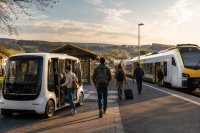
(PresseBox) - The discussion about autonomous mobility often focuses on the automation of individual vehicles. In fact, however, its greatest potential lies elsewhere: it opens up the possibility of improving public mobility where traditional scheduled services reach their limits. Especially for the first and last mile, in rural areas, during off-peak hours, or for small-scale service needs, new requirements arise that can only be met economically to a limited extent with rigid schedules and large vehicles.
The federal government explicitly describes autonomous driving as an opportunity to complement public transit and to create new mobility options, particularly in rural and outlying regions. The future of public transit therefore lies not only in larger networks, but in smarter connections. Autonomous services become relevant when they do not replace existing systems but rather complement them in a meaningful way: as shuttles to train stations, as on-demand services between neighborhoods, and as a way to fill gaps where scheduled service alone is unavailable, not precise enough, or not economical enough.
Integration Instead of Replacement
Future public transit will therefore not be defined exclusively by larger networks or higher service frequencies. Rather, the key lies in the intelligent integration of different mobility options. Autonomous shuttles can connect train stations, serve residential areas, or provide on-demand transportation without replacing existing scheduled services. Their added value lies in filling service gaps and meaningfully complementing existing services. As a result, public transportation is evolving from a predominantly route-oriented system into a more demand-oriented mobility network.
The handbook *Autonomous Driving in Public Transportation* also follows precisely this approach. Autonomous vehicles are described there as an integral part of integrated service concepts that link demand profiles, service models, and existing transportation structures.
New operating models pose new technical challenges
This development is also changing the requirements for vehicle and system architectures.
Flexible mobility services do not arise solely from autonomous driving functions. They require that vehicles remain continuously available, that transfers between different modes of transport function reliably, and that entire vehicle fleets can be safely coordinated. The more different mobility services are interconnected, the more important it becomes to ensure predictable vehicle movement, high system availability, and secure integration into control centers, fleet management, and digital transportation platforms. This shifts the focus from the individual autonomous trip to the overall system. What matters is not only that a vehicle can drive autonomously, but that it can be integrated stably and continuously into existing operational processes while remaining controllable at all times.
International developments reflect this shift
Internationally, this development is already being implemented in concrete ways. Singapore’s Ministry of Transport explicitly describes autonomous shuttle services as a complement to existing public transportation. The plan calls for fixed shuttle routes within urban neighborhoods that directly connect residential areas to train stations, markets, or medical facilities: “We will start by deploying autonomous shuttles to operate scheduled, fixed-route services within our towns.” “These shuttle services can directly connect residents to key transportation hubs and amenities such as the market and polyclinic.” Autonomous mobility is thus not viewed as an isolated technology project, but as an integral part of future local transportation structures.
Bitkom also points out that autonomous mobility can only realize its full potential in larger service areas and with scalable fleet concepts. The transition from demonstration to regular operation therefore requires not only high-performance vehicles but also robust operational architectures.
Vehicle control becomes the foundation of integrated mobility
This is precisely where Arnold NextG comes in. With NX NextMotion, the company is developing a fail-operational drive-by-wire platform that treats vehicle control as a standalone system layer. In doing so, NX NextMotion establishes the technical prerequisites for reliably integrating autonomous vehicles into integrated mobility services. It enables the safe electronic control of steering, braking, and propulsion, thereby laying the technical foundation for autonomous vehicles, teleoperation, and software-defined vehicle architectures. Especially in integrated mobility systems, controllable vehicle movement determines whether autonomous shuttles can be reliably integrated into existing transportation networks. Only when vehicles remain safely controllable at all times and are continuously available can flexible operating models be scaled and operated economically over the long term.
Conclusion
Local transportation of the future will not necessarily expand everywhere—but it will become smarter. Autonomous mobility delivers its greatest benefits where it complements existing transportation services, fills gaps in service, and organizes mobility more flexibly. However, for these new operating models to function in everyday life, more is needed than just autonomous driving functions. System architectures that integrate vehicles into existing mobility networks in a safe, reproducible, and continuously controllable manner are crucial. Only then will autonomous vehicle technology become a resilient component of future mobility systems.
We Control What Moves
For more information, visit www.arnoldnextg.com/blog
Über Arnold NextG:
Arnold NextG realisiert die Safety-by-Wire®-Technologie von morgen: das mehrfach redundante Zentralsteuergerät NX NextMotion ermöglicht eine ausfallsichere und individuelle Implementierung, fahrzeugplattform-unabhängig und weltweit einzigartig. Mit dem System können autonome Fahrzeugkonzepte sicher und nach den neuesten Hard- und Software- sowie Sicherheitsstandards umgesetzt werden, ebenso wie Remote-, Teleoperation- oder Platooning- Lösungen Als unabhängiger Vorausentwickler, Inkubator und Systemlieferant übernimmt Arnold NextG die Planung und Umsetzung – von der Vision bis zur Straßenzulassung. Mit der Straßenzulassung von NX NextMotion setzen wir den globalen Drive-by-Wire-Standard. www.arnoldnextg.de
About Arnold NextG:
Arnold NextG realizes the safety-by-wire® technology of tomorrow: The multi-redundant central control unit NX NextMotion enables a fail-safe and individual implementation, independent of the vehicle platform and unique worldwide. The system can be used to safely implement autonomous vehicle concepts in accordance with the latest hardware, software and safety standards, as well as remote control, teleoperation or platooning solutions. As an independent pre-developer, incubator and system supplier, Arnold NextG takes care of planning and implementation - from vision to road approval. With the road approval of NX NextMotion, we are setting the global drive-by-wire standard. www.arnoldnextg.com
Unternehmensinformation / Kurzprofil:
Über Arnold NextG:
Arnold NextG realisiert die Safety-by-Wire®-Technologie von morgen: das mehrfach redundante Zentralsteuergerät NX NextMotion ermöglicht eine ausfallsichere und individuelle Implementierung, fahrzeugplattform-unabhängig und weltweit einzigartig. Mit dem System können autonome Fahrzeugkonzepte sicher und nach den neuesten Hard- und Software- sowie Sicherheitsstandards umgesetzt werden, ebenso wie Remote-, Teleoperation- oder Platooning- Lösungen Als unabhängiger Vorausentwickler, Inkubator und Systemlieferant übernimmt Arnold NextG die Planung und Umsetzung – von der Vision bis zur Straßenzulassung. Mit der Straßenzulassung von NX NextMotion setzen wir den globalen Drive-by-Wire-Standard. www.arnoldnextg.de
About Arnold NextG:
Arnold NextG realizes the safety-by-wire® technology of tomorrow: The multi-redundant central control unit NX NextMotion enables a fail-safe and individual implementation, independent of the vehicle platform and unique worldwide. The system can be used to safely implement autonomous vehicle concepts in accordance with the latest hardware, software and safety standards, as well as remote control, teleoperation or platooning solutions. As an independent pre-developer, incubator and system supplier, Arnold NextG takes care of planning and implementation - from vision to road approval. With the road approval of NX NextMotion, we are setting the global drive-by-wire standard. www.arnoldnextg.com


Datum: 14.07.2026 - 15:00 Uhr
Sprache: Deutsch
News-ID 739142
Anzahl Zeichen: 8204
contact information:
Contact person: Anke Leuschke
Town:
Pfronstetten-Aichelau
Kategorie:
Pharmaceuticals & Biotech
Diese Pressemitteilung wurde bisher 98 mal aufgerufen.
Die Pressemitteilung mit dem Titel:
"Autonomous mobility in local transport requires a new system architecture"
steht unter der journalistisch-redaktionellen Verantwortung von
Arnold NextG GmbH (Nachricht senden)
Beachten Sie bitte die weiteren Informationen zum Haftungsauschluß (gemäß TMG - TeleMedianGesetz) und dem Datenschutz (gemäß der DSGVO).


